Monday, 22 February 2010

The Carnaval in Tenerife is Over…Thank Goodness

Don’t get me wrong, I’m not one of those people who moan and groan about noise, drunkenness, rowdy revellers and all sorts every time carnaval is mentioned. I love carnaval, but by the end of carnaval week I’m shattered.

When we first moved to Puerto de la Cruz a bank teller told us carnaval was for the young. At the time I thought she was an old sourpuss; however, I’m starting to come around to her point of view. The spirit is willing, but the body is weak and late night parties combined with standing for hours waiting for and watching parades takes its toll much more than it used to.

Carnaval didn’t start well, the new mayor (really an old mayor rehashed) decided in his infinite wisdom that Puerto wasn’t going to have an opening parade, so carnaval in Puerto de la Cruz got off to a damp squib of a start. However, we did get to eat doorstopper sized catalanas at the best food stall in the universe.

 By Monday night, usually one of the best party nights, carnaval fever had picked up and Andy and I ‘costumed up’ and headed into town for an overdose of partying and people watching.  If you want to get a real insight into the Tinerfeño character then you should experience a carnaval street party. Booze is consumed like there’s no tomorrow, yet in six years of attending these all night parties I’ve never seen a hint of trouble – only seas of slightly vacant, smiling faces.

An orange weather alert for high winds and rain put a bit of a dampener on the Burial of the Sardine which was postponed in both Santa Cruz and Puerto, but by Friday night, the worst of the weather had passed and the highlight of Puerto’s carnaval, the high heels drag marathon, was able to take place without threat of the contestants' skirts being blown over their heads – not that they would have been worried by that – flashing your drawers, or better (or worse depending on your position), fake genitals is almost compulsory. This year there were over 300 entries into the race and watching them all get introduced by the compere was a marathon in itself. My favourite outfit was a Shiva who had beer cans in some of her many arms.
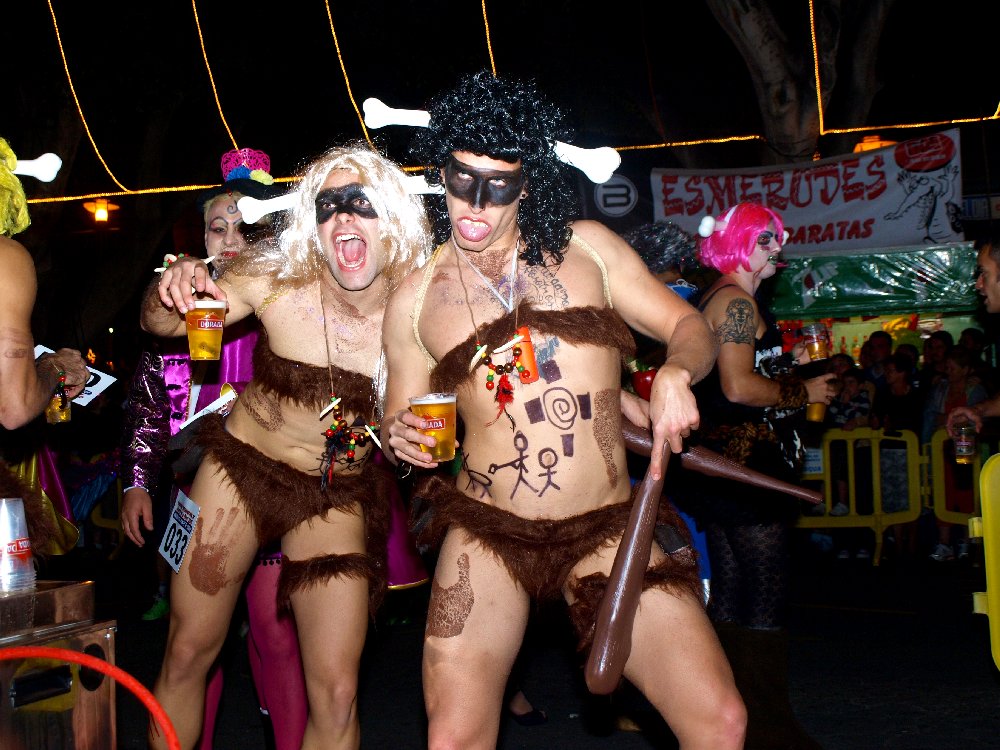
 
 By the time of the closing parade on Saturday, I was flagging. However, being one of the most photogenic events of the year it’s too good an opportunity to get some real stand out photos. The big decision is always where to position myself. I normally never get it completely right – the perfect quiet spot becomes flooded with people as soon as the parade starts; last year it was too sunny, creating dark, dark shadows – but this year I got lucky. It wasn’t full sunshine, but it was bright and I found a spot which remained remarkably people free allowing me to crouch, stand, kneel, stand on my head etc to get the angle I wanted.
 
 By the end of Saturday night I was both relieved and saddened that carnaval was over for another year. Of course to say it’s over is a bit misleading as it spreads out to other towns now, but although still fun they’re not quite in the same league as Santa Cruz and Puerto’s.

Anyone arriving in town this week will find a very different and subdued Puerto – that’s because everyone is exhausted. Come back in a month and we’ll all be desperate for the next fiesta.

Thursday, 11 February 2010

Living in Another Culture – Living on Tenerife is Different… Honest #2

 
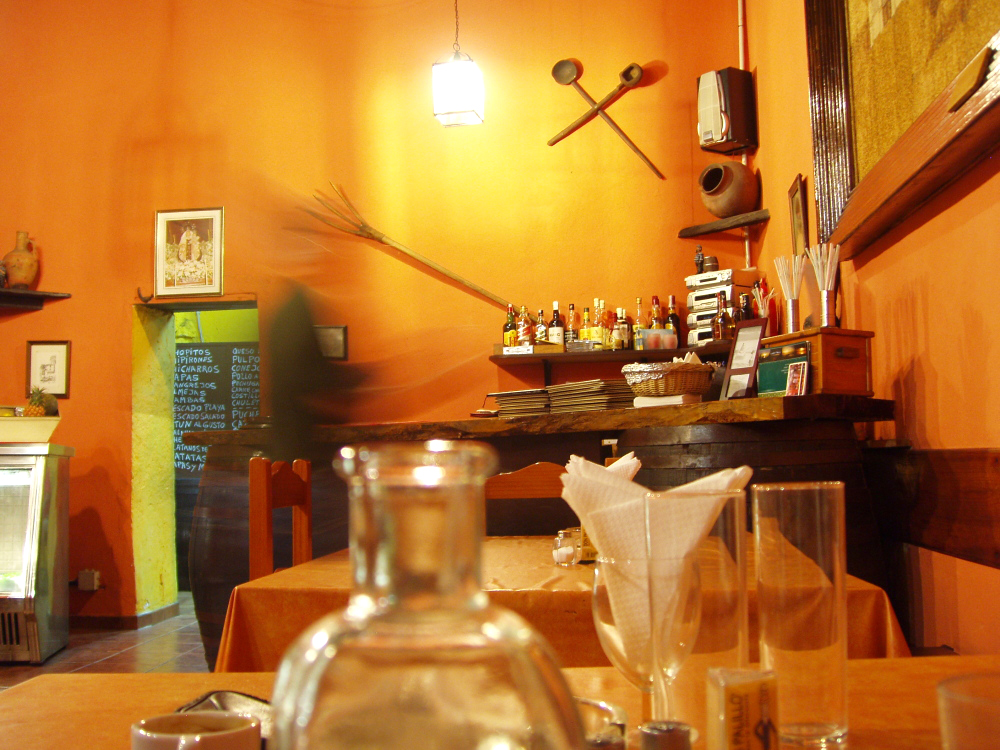
A couple of days after the British Guild of Travel Writer’s dinner we met up with travel writer and TV director, John Bell in Puerto de la Cruz and took him to one of our favourite places in the town, Cha Paula, an authentic Canarian restaurant in an old mansion.

Apart from experiencing the visually surreal ‘Chorizo de Teror’, John also discovered that the Canarian accent can have as much in common with Madrid Spanish, where John has spent quite a bit of time, as Rab C Nesbitt’s English has with the Queen’s.

“The accent’s a bit different isn’t it?” John commented after the owner, an intimidating-looking, but actually very friendly, shaven head Canario with an accent as thick as palm honey, had explained to us why pimientos de padrón grown on Tenerife weren’t spicy.
His Canarian Spanish led to a discovery of a way to serve coffee that I certainly had never seen before.

As John tried to order a type of coffee he’d seen people drinking in cafes, but wasn’t sure what it was called, the owner thought for a second and then suggested something that sounded like 'cafayconwello'.

“That’s it!”
declared John and then turning to us, asked. “What did he say?”
“Café con hielo,” Andy answered. “Coffee with ice.”

Sure enough, Cha Paula’s owner returned with an espresso sized cup of coffee and a huge tumbler filled with ice. Clearly the ice couldn’t fit into the cup, so John poured the coffee over the ice.

“What does it taste like?”
I asked, intrigued by this unusual method of serving coffee.
“Slightly cold coffee,” was the amused and probably obvious reply.

When the owner came back to the table we asked if this was a popular way to serve coffee.

“For Canarios, no,” he shrugged, then added. “But maybe for peninsulares...sometimes.” With an expression which said, ‘the mainland Spanish are probably strange enough to try something like this’.

It was one of those delicious little moments which illustrated that everyday life in the real Tenerife can be different even if you’re familiar with the ways of mainland Spain.

Wednesday, 10 February 2010

Living in Another Culture – Living on Tenerife is Different… Honest #1

One of the funny things about Tenerife is that its modern image has been shaped more by tourism over the last 40 years than the reality of what life on most of Tenerife is really like and has been like for 500 years.

The British Guild of Travel Writers held their annual general meeting on Tenerife recently and Andy and I attended their gala dinner where we got chatting to a number of the members.

I found that when I was asked ‘why did you move to Tenerife?’ and I answered ‘to experience living in a different culture’ (that was the pretentious answer – the lure of warm weather also figured highly) that I also felt obliged to explain that living anywhere outside of the main, purpose built resorts can be like living a million miles from the Tenerife that many had an image of in their minds.

I sat next to a charming lady at the BGTW dinner who spent 4 months of the year on the island of Zante in Greece. We swapped stories about the quirks of life in another culture – good and bad. She told me of the mayor who used the police as his personal heavies; arresting people who he didn’t like and arranging when holes in roads were repaired that the ones in front of the house of people who didn’t vote for him were left unfilled. I countered with the Tenerife mayor who posted a policeman outside of the butterfly gardens to deter visitors because of a personal dispute and another mayor who recently had three young journalists physically removed by the police from a public session of the council because they were posting news straight onto the web – clearly he’s not quite up to scratch with this new-fangled internet thingy.

Mostly though, our stories were about the positive quirks – and thank god these outweigh the ones that have you turning all Herbert Lom in The Pink Panther movies. It’s been what we call a frustrating TIT of a week (This Is Tenerife). But it was nice to share tales with someone from outside of the island who confirmed my suspicions that getting to grips with a different culture wherever you are usually involves a willingness to accept that things may not be quite as organised, or work as smoothly as you've been used to. But then that's part of the charm...most of the time.

Thursday, 21 January 2010

Photographing Tenerife – The Good, The Bad and The Ugly

We’ve recently been writing a series of short guides to many of Tenerife’s towns and resorts.
I’ve got an extensive library of photographs for most places on Tenerife, but the job made me realise that a couple of years had passed since I’d taken new photos of some locations.

In that period I’d been concentrating more on fiestas, events and walking locations rather than the towns and villages, so I decided it was time to bring my photo library up to date.

When we wrote the in depth location reports for Living Tenerife Magazine, part of the remit was to provide photographs which made each location look as good as possible. Sometimes this was easy – I could have sent the cat with the camera and the results would be great; sometimes it took a bit of creative thinking – a flowering oleander, or hibiscus bush could be a godsend for partly obscuring an eyesore which could ruin an otherwise attractive scene; and sometimes I’d spend ages staring and staring at places to try to spot something that looked remotely photogenic – an unusual doorknob, a bright flower in a glass on a restaurant table…anything.

Anyway, having been spoiled with the spectacle and colour of numerous fiestas and the drama of the epic countryside I’d partly forgotten that some places, like some people, don’t pose well.
I know my personal preferences are partly to blame. I like old places whose character positively oozes from the brick and plaster work so locations like La Orotava, La Laguna, Garachico, Santa Cruz and parts of Puerto de la Cruz are on the whole easy. Imaginative modern architecture is also good, so that’s another plus for Santa Cruz.

Marinas and harbours are usually good subjects, especially if there’s also a resident fishing community – Los Cristianos, Las Galletas, El Médano and to a lesser extent Puerto Colón, Playa San Juan and Los Gigantes (but that does have those stunning cliffs).

A nice beach can make up for dull characterless buildings, lack of expanses of greenery or unique individual touches – parts of Costa Adeje and Playa de las Américas; however, in the more upmarket areas of both, luxury hotels with individualistic architectural styles, trendy shopping centres and pavement cafés have added some interest.

But for me there are a couple of places on Tenerife which have me praying for photographic inspiration. Resorts where there are no beaches, the architecture is decidedly seventies, there are no plazas, quaint or otherwise and there’s an absence of creativity in the décor of the restaurants and cafés.

They are nice places to visit on holiday I’m sure; plenty of decent restaurants and loads of sunshine, but for the life of me, I can’t find anything that gives either an individual character.

 And these places are…well it wouldn’t be fair to pass my photographic prejudices on to you and I actually quite like one of them despite the fact I can’t photograph it for toffee. So you’ll just have to figure it out for yourself while I try for the umpteenth time to try to take a half decent shot of the damn places.

Thursday, 7 January 2010

Looking for an Atmospheric Tapas Restaurant on Tenerife


Anyone who enjoys spending a leisurely lunch lingering over a taste-bud teasing selection of tapas dishes accompanied by a carafe of local vino will find that, depending where they’re staying on Tenerife, finding an atmospheric tapas bar will either be as easy as falling off a log, or as difficult as getting a flight out of a UK airport at the moment.

On my birthday I enjoy having a long tapas lunch. In Puerto de la Cruz we’re spoiled for places to have tapas. There were twenty eight bars and restaurants participating in a recent ‘ruta de la tapa’ (a council sponsored competition to find the best tapas in town). These aren’t all the places in Puerto that serve tapas, just the ones which had opted to participate. We only managed to get around six of the restaurants and the tapas in each were a delight. But what added to the experience was the ambience and surroundings which ranged from interior courtyards of colonial mansions to stylish terraces to pavement cafés overlooking charming squares. Like I said we’re spoiled in Puerto.

On my birthday I opted for a place we hadn’t been to before, Tasca El Olivo, on one of the back streets behind Plaza del Charco. It’s not the most picturesque location in town, but being situated beside a Cuban bar whose salsa music added a South American soundtrack to the scene, it was atmospheric and we whiled the afternoon away eating the most delicious tapas and people-watching.

Rewind a few weeks and we’re researching in Costa Adeje around the San Eugenio/Torviscas area. There are hundreds of places to eat and if we wanted burgers, toasties or bocadillos (filled baguettes), or even a meal in a nice restaurant we’d be fine. However, when we’re out and about working, we like to try a couple of tapas dishes in a quaint little bar/restaurant if possible. We were on a hiding to nothing.

A couple of days later we’re in a couple of other resorts carrying out more research – same result. There just wasn’t anywhere that fitted the bill and in the end on both occasions, we settled for baguettes in pleasant, but run of the mill establishments.

Admittedly it’s difficult for resorts which have only been in existence for a few decades at most to meet the ‘quaint’ requirement. If you’re in Santa Cruz, La Laguna or La Orotava, you’ve got five hundred years of history to add to the overall ambience and that’s something that’s almost impossible to replicate.

But it’s not impossible. Los Cristianos has a wonderful selection of contemporary tapas bars in the San Telmo area. El Médano has great tapas restaurants overlooking the harbour and even small places like up and coming Alcalá has a couple of inviting tapas bars around its small square. And there are plenty of others like them.
But then these three were towns or villages first and that’s where for me the difference lies.

For many years establishments in some parts of the main southern resorts have occupied the culinary middle ground, offering familiar ‘international’ menus to appeal to the masses.Recently that’s changed in the newer, more upmarket areas.

But generally speaking, if you want to try some local tapas in an ambient bar where the atmosphere complements the food on your plate, look to the towns that were already in existence before the mass tourism boom of the 70s.

Monday, 21 December 2009

A Month Going Native in Tenerife #3: From Exploding Tapas to Tsunami-Sized Waves


Enjoying a lively Christmas lunch in the courtyard of a museum party was a fittingly surreal topping to the last few weeks in Tenerife.

Exploding Tapas in Puerto de la Cruz
The period had started bizarrely enough when we took my sister and her boyfriend, who were on holiday in Playa de la Arena on a tapas route around the town. Some great tapas dishes were tested; however, the one which got the best reaction wasn’t the tastiest, but the oddest. Ravioli filled with space dust in Casa Pache was quite unlike anything I’d ever tasted. No wonder they called it ravioli sorpresa.


Volcanic Eruptions on Tenerife
The 18th of November saw the centenary of the last eruption on Tenerife at Chinyero above Santiago del Teide. We went along to see how it was being celebrated and stood on the edge of the volcano as a load of suits, looking completely inappropriately dressed for trekking across a lava field, posed for photos with Ricardo Melchior, the Island’s President (who was at least dressed for the countryside). The event also coincided with the opening of Santiago del Teide’s new cultural centre set in and around the lovely old buildings of Casa El Patio. We’d first clocked the building about three years before, when its estimated opening date was already 6 months behind schedule. In Tenerife time that’s not bad. On maps of Puerto de la Cruz, the car park at the harbour has been identified as ‘futuro parque marítimo’ for about 20 years.

Chestnuts, Wine and Street Sliders
This year’s arrastre de las tables, where local lads scream down steep streets to celebrate San Andrés in Icod de los Vinos was a bit of a washout. Much more enjoyable was partaking of a poke of chestnuts and some new vino tinto around the harbour in Puerto… if you could get a seat. It’s the sort of thing that Puerto does brilliantly. The smells, tastes and sounds were a reminder that for anyone wanting to sample the real Tenerife and do the sort of things that Canarios enjoy doing, Puerto’s hard to beat.

Yellow Weather Alerts on Tenerife #1 The Rain

November is always a dodgy month on Tenerife. It’s the month that the rains can return with a vengeance after the long dry summer. We always advise people that if they’re coming to Tenerife for only a week and want some sunshine, don’t come to the north in November or February. The rains don’t normally last long, but when they come you know about them. This year’s were the worst we’d seen since we moved here and although they only lasted about 24 hours, they left chaos in their wake and destroyed part of the town beach.


Christmas on Tenerife
The Christmas lights in Puerto this year are a bit of a disappointment. They’re very nice and tasteful, but lack a bit of colour. Thank goodness then for a completely over the top psychedelic big wheel, whose frantically whizzing neon lights dominate the town’s skyline. The funfair in Puerto’s harbour is part and parcel of Christmas here, as are aisles full of turrón in the supermarket – we’re on our third packet of the season.

Snow on Mount Teide
They were a bit late in coming and they didn’t stay long, but the first snows of the year fell on Mount Teide’s slopes last week.  We’re hoping that more falls during the next week so that we can say we’ve had a white Christmas on Tenerife.
 
Yellow Weather Alerts on Tenerife #2 The Waves
Some people panic when they hear there’s a weather alert on Tenerife, but when the alerts for big waves, it’s more of a heads up to experience nature’s show than to batten down the hatches. Last week I was hoping to see some surfers tackling ‘El Bravo’, but although the waves turned up as promised, the surfers didn’t… hey ho.

Christmas is almost upon us, so with Christmas concerts during the next week, New Year’s celebrations and the Tres Reyes parades there are a few things that we’re looking forward to before the fiesta season starts again in January.


Feliz Navidad Todos

Wednesday, 9 December 2009

Going Native in Tenerife – Eating Where the Locals Eat


There’s a rule when it comes to recommending restaurants that is applied in nearly every travel guide book and also in countless travel articles.

It’s this: A restaurant where the locals eat must be the place to eat. As rules go, it’s not a bad one. We’ve applied it everywhere we’ve visited and usually ended up enjoying a good meal.

However, living in Tenerife and getting to know the local culture and quirks has made me view this rule slightly differently and with slightly more caution.

Firstly, as we talk about in 'Going Native in Tenerife' in more detail, Canarios generally have a conservative nature when it comes to dining. They like Canarian food which tends to be simple dishes of grilled meat and fish with papas arrugadas (literally wrinkled potatoes). Any vegetable or salad accompaniment isn’t usually the most imaginative in the world.
The mainland Spanish don’t always hold Canarian cooking in high esteem and I’ve had restaurant owners go out of their way to make it clear that their restaurant serves Basque, or Galician dishes rather than Canarian.

Canarios aren’t the best at experimenting with food from other countries apart from maybe Italian. So what that means is that when you see a restaurant filled with Canarios, you can bet your house on the fact that the menu will be traditional Canarian cooking and almost exactly the same as every other Canarian restaurant on the island.  However, lots of local clients usually means that the food served will be a notch above other restaurants dishing up the same fare. La Tasquita de Min beside Puerto’s harbour is a prime example of this. Their fish is simply prepared and divine tasting (the parrot fish, vieja, is particularly good) and on Sundays it’s almost impossible to get a table as they are filled with well to do Canarios.


But whilst full tables may be a sign of the best Canarian restaurants, it doesn’t necessarily mean that they're the best restaurants full stop. In areas which are popular with a mix of nationalities, there’s a choice of dining from all over the world, but they might not be frequented by ‘locals’, or Canarian locals anyway.

And this raises another factor which applies to places where there is a high ex-pat population. And that is what people mean when they use the term ‘local’.

In an article we wrote about restaurants in Valle Gran Rey on La Gomera, we include a cheap and cheerful joint which served up everything from Canarian cooking to pizzas. When we told our friend who lives on La Gomera that we were including this restaurant she announced:

“But no locals ever eat there.”

Her statement surprised us because when we’d eaten there the other diners included a large group of workmen and some young couples – all Canarios.

It turned out that the locals she was referring to were the resort’s large, German ex-pat population.

Similarly on websites like Tenerife Forum, the majority of whose members mainly live or holiday in the south of Tenerife (where most of the British ex-pat population reside) when people talk about places the locals eat, they might be referring to ex-pat locals rather than ‘Canario’ locals.

Clearly it’s legitimate to use the term local for someone who lives here irrespective of where they originated. But if you’re planning a holiday, or even looking for a place to live for a while, it’s a distinction that you need to be aware of the next time someone recommends somewhere because it’s ‘where the locals eat’.